





Freno de prensa hidráulico 600T–3000T: Casos de uso y riesgos con gran formación
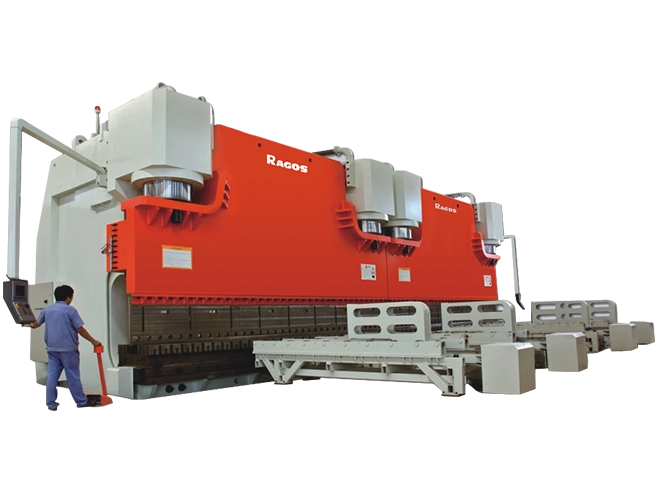
La transición a frenos de presión hidráulicos de ultra alta tonelaje (600T–3000T) representa un cambio fundamental del flexión de chapa metálica al conformado de placas pesadas. A estas escalas, La física de la flexión del aire está dominada por fuerzas de resistencia masivas, donde la estructura cristalina interna del material dicta el comportamiento de la máquina más que la interfaz de control del operador. La precisión en este escalón no es solo cuestión de precisión lineal, sino de una batalla compleja contra la desviación de frames, Retorno de material, y la energía necesaria para iniciar una bisagra plástica en aleaciones de alta resistencia. No respetar la física de carga de estas máquinas no implica que una pieza se desguace.; Esto provoca un compromiso estructural catastrófico de las herramientas o del propio bastidor de la máquina.
- Necesidad de ultratonelaje: Impulsado por la infraestructura global, Construcción naval, y sectores energéticos que requieren integridad monolítica de placas.
- Dominio en física de placas: Más allá de 600T, Los gradientes de esfuerzo de grosor atravesando hacen obsoletos los cálculos estándar de factores K.
- Trayectorias estructurales de carga: Las clasificaciones de tonelaje son secundarias a la capacidad de la máquina para canalizar energía sin torsión.
- Riesgo de fallo catastrófico: El almacenamiento de energía en un bastidor desviado de 3000T convierte fracturas menores de herramientas en proyectiles de alta velocidad.
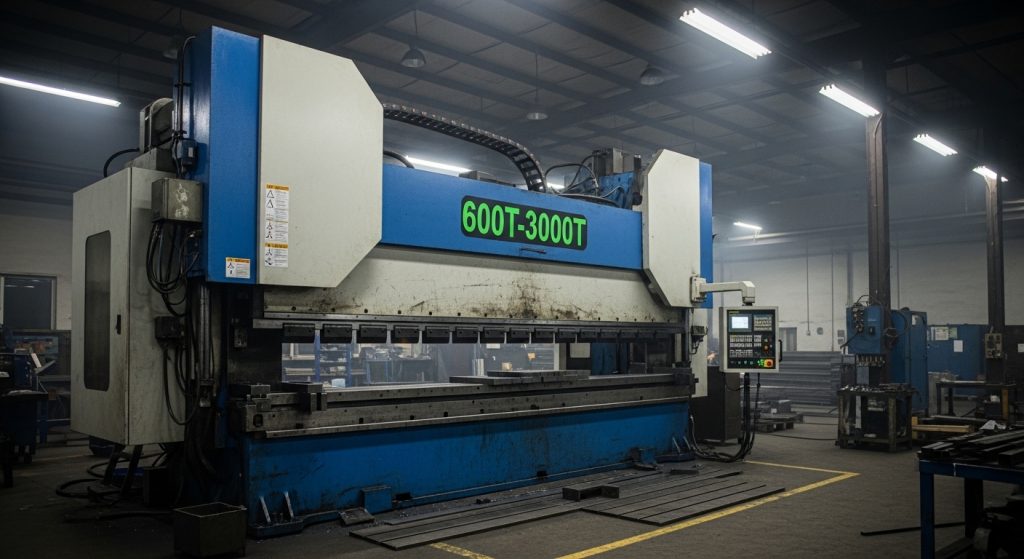
La envolvente de física de carga por encima de 600 toneladas: Qué cambios en el comportamiento del metal
Al procesar placas pesadas en una máquina de 600T a 3000T, El material ya no se comporta como un plano uniforme. Un campo de tensiones triaxial se desarrolla en el punto de contacto, donde la profundidad de penetración de la zona plástica debe alcanzar el eje neutro antes de que ocurra cualquier deformación permanente. En materiales más finos, Esta transición es casi instantánea; sin embargo, en placas ultrapesadas, La propagación del frente de flujo se mueve lentamente, creando una acumulación masiva de resistencia interna.
Comportamiento de los materiales bajo tonelaje ultra-alto
| Métrica | Umbral de 600T | Umbral de 3000T | Impacto en la ingeniería |
| Tipo de campo de tensiones | Dominante biaxial | Triaxial dominante | Mayor riesgo de delaminación interna. |
| Desplazamiento del eje neutro | Minimal | Significativo | El cálculo de la longitud en blanco se vuelve no lineal. |
| Propagación de bandas de corte | A nivel superficial | Grosor completo | Requiere velocidades de RAM más lentas para evitar grietas. |
| Almacenamiento de energía por deformación | Moderado | Extremo | La máquina debe disipar una enorme energía de retroceso. |
Distribución de tensiones estructurales en el bastidor en frenos de presión hidráulicos 600T–3000T
En el límite de 3000T, El bastidor del freno de presión actúa más como un puente que como una máquina herramienta. El flujo de tensiones longitudinales de la viga debe gestionarse meticulosamente para evitar "banana" deflexión. Los fabricantes utilizan diseños de tirantes de estructura en C o estructura de caja de alta resistencia para asegurar que la transferencia de carga por compresión de la columna se mantenga vertical. Si se supera la resistencia a la distorsión torsional del bastidor, El RAM perderá el paralelismo, lo que provoca longitudes de brida desiguales y sobrecarga localizada de herramientas.
- Deflexión de la cama: Incluso con sistemas de corona, El lecho sufre una deformación elástica significativa que debe compensarse en tiempo real.
- Simetría del cilindro hidráulico: La fuerza debe aplicarse con absoluta sincronía; un milisegundo de retardo a 3000T crea una carga lateral masiva sobre las guías de RAM.
- Paralelismo de Ram: Se logra mediante codificadores lineales de alta resolución que monitorizan la simetría de fuerza del cilindro hidráulico frente a la retroalimentación estructural del bastidor.
Comportamiento de la presión hidráulica a niveles de tonelaje ultra-altos
Gestionar la hidráulica a esta escala requiere más que solo alta presión; Requiere una lógica sofisticada de control de flujo. La compresibilidad del fluido se convierte en una variable tangible—a 300 bar, El aceite hidráulico puede comprimirse casi un 1% de su volumen. Esto crea un "Primavera" efecto en los cilindros que debe gestionarse mediante la modulación proporcional de válvulas servo para evitar movimientos erráticos del cilindro durante la transición de un enfoque rápido a la velocidad de presión.
- Amortiguamiento por picos de presión: Las válvulas de alta velocidad evitan la propagación de ondas de presión que podrían romper los sellos durante la rotura o ruptura de la placa.
- Comportamiento de la carga térmica: El volumen de petróleo que se mueve genera un calor considerable; La deriva térmica hidráulica de expansión puede afectar la precisión de la carrera si no se gestiona mediante refrigeración activa.
- Sincronización multicilíndrica: Las máquinas de gran formato suelen usar 4 o más cilindros, requiriendo un PLC dedicado para equilibrar el flujo basado en datos de celdas de carga en tiempo real.
Modos de fallo únicos de las máquinas de conformado de ultratonaje
En el rango 600T–3000T, "Desgaste" es reemplazado por "fatiga y fracturas." El modo de fallo más peligroso es la singularidad de esfuerzo localizada, donde un defecto microscópico en la herramienta o la placa se convierte en un punto de fallo estructural total bajo carga.
Matriz de fallo de ultratonelaje
| Modo de fallo | Causa raíz | Gravedad | Señales de advertencia |
| Fractura por fatiga del chasis | Acumulación de fatiga por esfuerzo cíclico | Crítica | Descascarado de pintura en las uniones; audible "Pings" Durante la carga. |
| Fractura catastrófica de la herramienta | Brecha del umbral de tenacidad a la fractura | Extremo | Micro-grietación en los hombros del chip en V. |
| Placa de represión | Liberación repentina de energía de deformación | Alto | Vibración rápida de la placa tras la carrera. |
| Reventón del sello hidráulico | Propagación de ondas de presión | Moderado | Niebla hidráulica o caída repentina del plato. |
Los fallos de conformado pesado rara vez son graduales. Una vez que la red de propagación de la microgrieta alcanza un estado crítico, La fractura final ocurre a la velocidad del sonido dentro del material.
Grosor de placa frente a curva de fuerza: Cuando la formación se vuelve exponencial
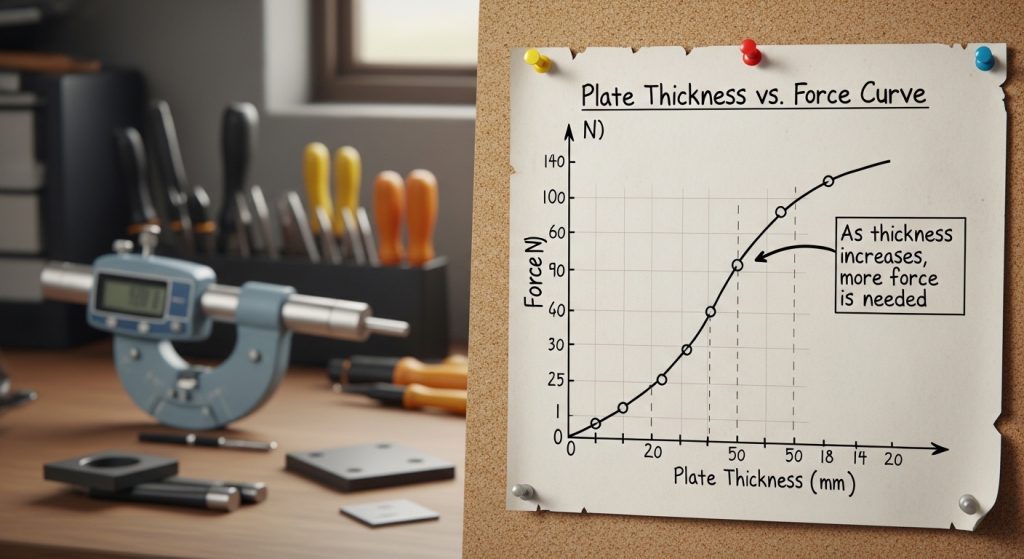
La relación entre el grosor de la placa y la fuerza requerida no es lineal; es aproximadamente una relación de grosor al cuadrado. Al pasar de una placa de 20 mm a una de 100 mm, La escalada de la resistencia del módulo de sección es masiva. Esto crea un gradiente de amplificación de carga donde un pequeño aumento en el grosor de la placa requiere una máquina desproporcionadamente mayor.
- Crossover elástico-plástico: El punto donde la placa deja de resistirse y empieza a deformarse.
- Formación de bisagras plásticas: La zona localizada de la curvatura donde el material alcanza la resistencia máxima a la tracción.
- Absorción de energía por deformación: La energía total que retiene la placa; Los tonelajes más altos deben permanecer en la parte inferior de la carrera para permitir que esta energía se disipe.
Restricciones de ingeniería de instalaciones por encima de máquinas 1000T
Un freno de presión 3000T no puede colocarse simplemente en un suelo de fábrica estándar. La losa de dispersión de carga de cimentación debe ser diseñada para evitar que la máquina se hunde o se incline con el tiempo.
- Refuerzo de los cimientos: Se requieren cimientos de pilotes profundos con rejillas de varilla pesadas para soportar el peso estático (a menudo >200 toneladas) y la fuerza de presión dinámica.
- Aislamiento de vibraciones: El aislamiento armónico de vibraciones evita que la enorme energía de la carrera dañe maquinaria de precisión cercana.
- Demanda eléctrica: Estas máquinas requieren alimentaciones de alta corriente para accionar simultáneamente múltiples bombas hidráulicas de 50HP+.
Cuando la placa es pesada, el conformado debe cambiar a rodar en lugar de doblarse
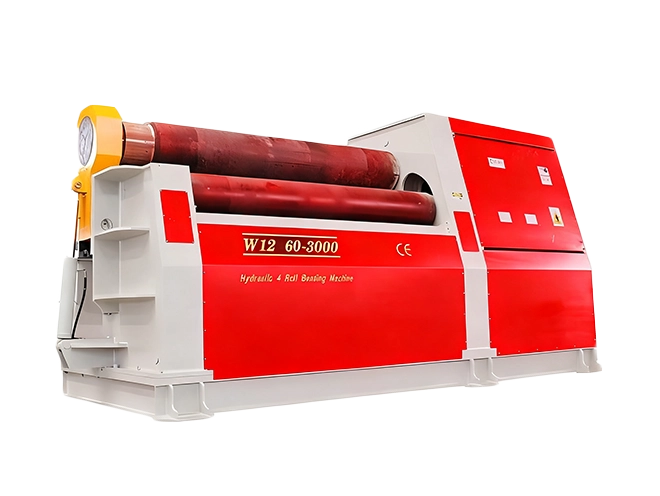
A grosores extremos o radios reducidos, un freno de presión se vuelve ineficiente. Se requiere una matriz de decisión para determinar cuándo pasar de un freno de presión a una máquina de laminación de placas.
| Factor | Usa freno de presión | Utiliza rodillo de placas |
| Min. Radio | Determinado por el dado V ($>3t$) | Puede lograr curvas continuas más cerradas. |
| Longitud de la placa | Limitado por el ancho de la máquina. | Puede manejar cilindros extremadamente largos. |
| Espesor | Generalmente hasta 100mm-150mm. | Puede superar los 200 mm para trabajos específicos en buques. |
| Complejidad | Mejor para múltiples ángulos/bridas. | Lo mejor para conformado cilíndrico de 360°. |
Modelado de riesgo económico para la propiedad de máquinas de ultra-alto tonelaje
Invertir en una máquina de 2000T o 3000T supone un compromiso de capital a 20 años. El modelo de ROI debe tener en cuenta más que solo "partes por hour."
- Punto de equilibrio de utilización: Estas máquinas suelen necesitar solo un 30-40% de utilización si el valor añadido del proyecto es alto.
- Ciclo de vida de las herramientas: Los chips personalizados para máquinas de 2000T pueden costar decenas de miles de dólares.
- Densidad de proyectos: El riesgo es alto si la máquina depende de un único contrato gubernamental o sector industrial.
Tabla de Escenarios de ROI
| Métrica | Alta utilización (Infraestructura) | Baja utilización (R personalizado&D) |
| Periodo de recuperación | 3–5 años | 8–12 años |
| Riesgo de inactividad | Crítica (Pérdida de ingresos) | Manejable (Cambio de horario) |
| Perfil de mantenimiento | Preventivo/Agresivo | Basado en la condición |
Comprendiendo el Capacidad de 3200mm frente a 4000mm las diferencias son esenciales para proyectos que se encuentran al borde del territorio de fabricación pesada. Mientras que un Freno de presión de 3200 mm sirve como columna vertebral para trabajos estructurales de gama media, el Freno de presión de 4000 mm a menudo marca el punto de entrada a infraestructuras pesadas. Para componentes ultralargos que superan la longitud de la cama de una sola unidad, Sistemas de frenos de prensa en tándem proporcionar una alternativa sincronizada a las máquinas monolíticas. También cabe destacar que la física del extremo inferior, como Flexión de láminas a 10 mm, proporcionar los datos base utilizados para extrapolar las fuerzas extremas requeridas para el rango 600T–3000T.
Reflexión final: El conformado con tonelaje ultraalto es tanto un ejercicio en ingeniería civil como en la fabricación de metales. El éxito requiere una visión holística de la máquina, El material, y la instalación que habita.